
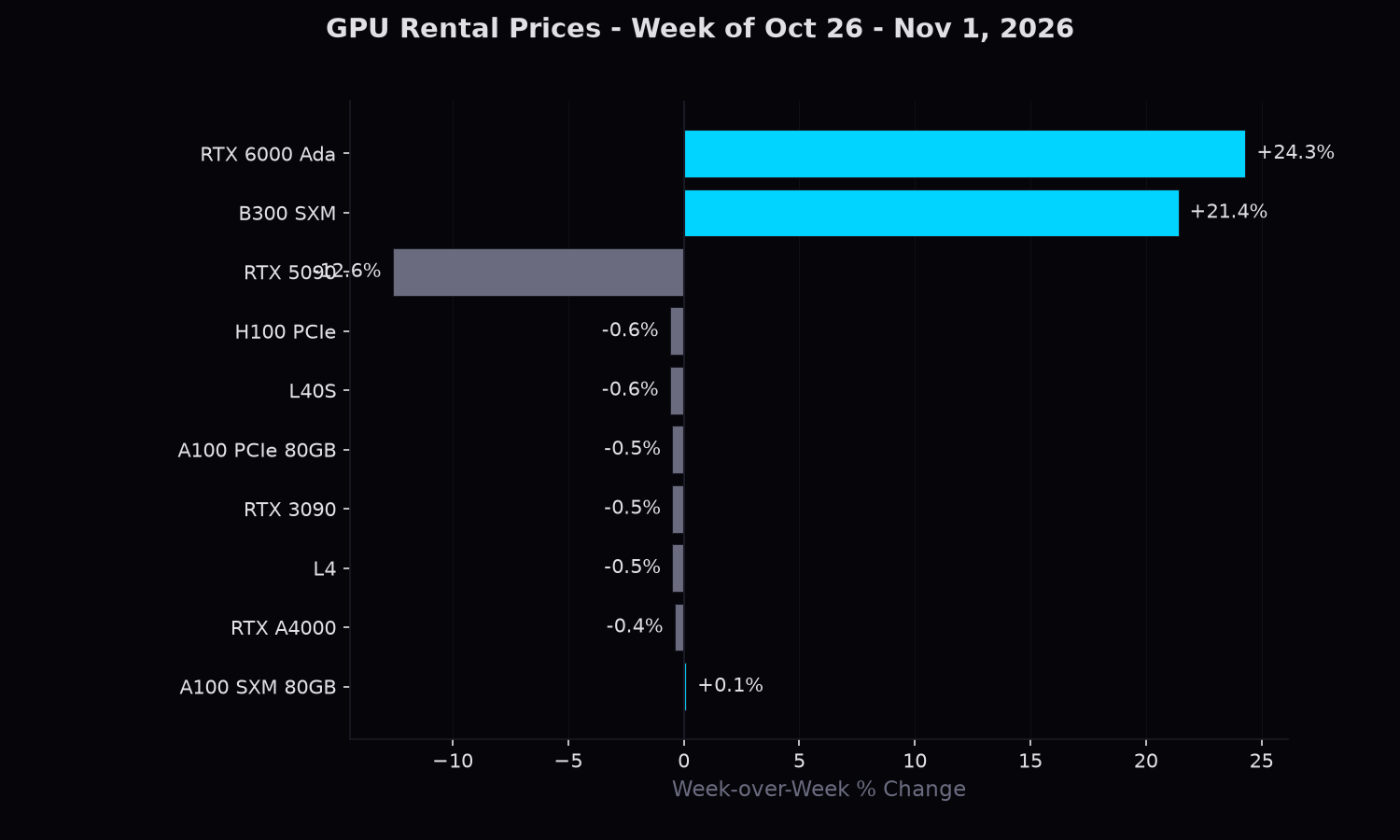
The H100 PCIe slipped 0.6% week-over-week, with the observed median rental rate declining from $3.14 to $3.12 per GPU-hour, according to AIMC observations. That narrow nominal move masks a more consequential story: meaningful dispersion persists across individual marketplaces, where the spread between the lowest and highest listed rates remains wide enough to matter for operators managing large-scale deployments. This report examines where the H100 PCIe is currently priced on a marketplace-by-marketplace basis, how those individual data points distribute around the median, and how this week's positioning compares to last week's. The per-marketplace breakdown follows below.
This Week in Numbers
- Focus SKU: H100 PCIe
- Week-over-week move: -0.6% ($3.14 → $3.12 median across covered marketplaces)
- Marketplace coverage: 10 marketplaces, 307 observations this week
- Price range: $1.00/hr at ionet to $3.57/hr at oblivus
AIMC tracked H100 PCIe across 10 authorized marketplaces this week. Full partner list at aiminingco.com/data-partners.
H100 PCIe — Pricing by Marketplace
| Marketplace | Min | Median | Max | Observations |
|---|---|---|---|---|
| ionet | $1.00 | $1.00 | $1.00 | 14 |
| dataoorts | $1.74 | $1.74 | $1.74 | 7 |
| hyperstack | $2.50 | $2.50 | $2.50 | 21 |
| quantacloud | $2.59 | $2.59 | $2.59 | 11 |
| massedcompute | $2.73 | $2.73 | $2.73 | 21 |
| runpod | $2.89 | $2.89 | $2.89 | 7 |
| ovhcloud | $3.12 | $3.13 | $3.28 | 198 |
| thunder | $3.20 | $3.20 | $3.20 | 7 |
| latitude | $3.37 | $3.37 | $3.37 | 7 |
| oblivus | $3.50 | $3.57 | $3.64 | 14 |
Spread Analysis
Across the 10 marketplaces carrying H100 PCIe this week, the observed median ranged from $1.00/hr at ionet to $3.57/hr at oblivus — a 3.6x spread between the lowest and highest median. Intra-SKU spreads of this magnitude reflect differences in commitment terms, regional availability, and how aggressively each provider is positioning the same hardware, rather than differences in the silicon itself. AIMC reports each marketplace's observed median independently and does not blend them into a single figure that would mask this dispersion — the spread itself is part of what the market is telling you.
Observation depth for H100 PCIe this week totaled 307 listings across 10 marketplaces. Marketplaces with deeper listing counts contribute more stable medians; those represented by a single listing are shown for completeness but carry correspondingly less weight in interpreting where H100 PCIe is clearing.
What This Means
The H100 PCIe's week-over-week median movement of negative 0.6 percent is, in isolation, a modest figure — small enough that it may reflect nothing more than normal compositional noise in which listings appeared or disappeared across the ten marketplaces Ai Mining Co. tracked during this period. What is analytically more substantive is the dispersion sitting beneath that headline number. AIMC's data shows a 3.6x spread in median per-hour pricing for the same physical SKU, ranging from $1.00 on io.net to $3.57 on Oblivus, with the remaining eight marketplaces distributed across that range rather than clustering tightly around a central value. A spread of this width on a single, well-specified chip suggests that the H100 PCIe market is not yet operating as a unified, efficiently arbitraged commodity market. Instead, what the data suggests is a collection of distinct sub-markets where commitment structure, contract duration, regional supply concentration, and platform-level buyer composition appear to be doing meaningful work in explaining price differences — even if the precise weighting of each factor cannot be confirmed from pricing data alone.
The positioning of individual marketplaces within that spread is worth noting without over-interpreting. Platforms with lower observed medians may be reflecting shorter average commitment terms, higher supply availability, or buyer bases that are more price-sensitive and willing to tolerate less service wrapping around the raw compute. Platforms at the upper end of the range, Oblivus at $3.57 being the clearest example, may be serving demand segments where factors beyond raw per-hour cost — reliability guarantees, geographic specificity, or enterprise contracting norms — are absorbing some of the price premium. None of these explanations can be confirmed from a single week of median prices, but the structure of the spread is consistent with a market where the H100 PCIe label is a necessary but not sufficient descriptor of what is actually being purchased.
One week of data describes a snapshot, not a trend, and that constraint matters here. The negative 0.6 percent move and the $1.00-to-$3.57 range characterize a specific seven-day window and should be read as a baseline observation rather than as evidence of direction. What the data does establish clearly is that buyers and operators treating H100 PCIe pricing as a single number are working with a significant abstraction — the observed dispersion is too wide, and too structured across named platforms, to be dismissed as noise.
Methodology & Coverage
This weekly report is generated from pricing data collected daily across all authorized data partners listed at aiminingco.com/data-partners. Coverage includes on-demand rates published by each marketplace. Spot pricing, reserved instance rates, and enterprise contracts are excluded.
For complete methodology, data collection schedule, and quality controls, see aiminingco.com/methodology.
This report contains observable market data only. No estimates, no forecasts, no buy/sell recommendations.